WHAT DEFINES PROCUREMENT? BEYOND THE COST CENTER DEBATE
The Unconscious Battlefield of Procurement
Abstract
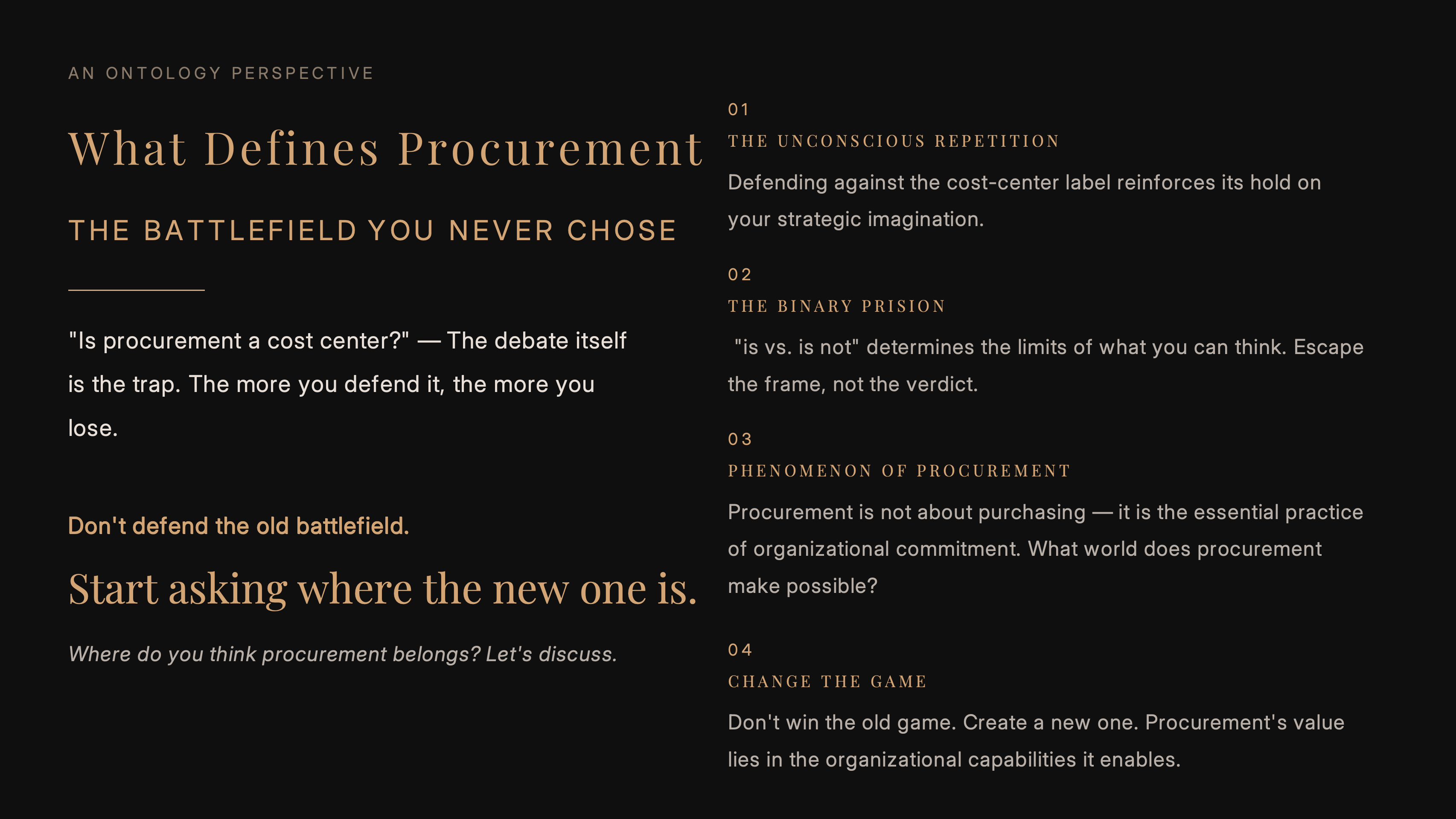
The contemporary discourse surrounding procurement's organizational role has become imprisoned within a singular, repetitive question: Is procurement a cost center? This article argues that the debate itself constitutes a structural trap—an unconscious battlefield where the very act of defending or refuting the cost-center label reinforces the conceptual framework that procurement seeks to escape. Through four distinct lenses—examining the hidden patterns of unconscious repetition, the prison of binary language, the return to essential experience, and the art of creating new competitive space—this research deconstructs the mechanisms through which procurement professionals unknowingly perpetuate their own strategic marginalization. The analysis reveals that procurement's true transformative potential lies not in winning the existing argument, but in fundamentally redefining the terrain upon which organizational value is contested.
1. Introduction: The Trap of the Debate
Everyone is debating whether procurement is a cost center. LinkedIn posts, conference panels, and boardroom presentations all converge on this singular preoccupation. Yet I contend that the debate itself is the trap. The more you defend procurement against the cost-center label, the more you lose—because you are fighting on a battlefield you never chose.
Consider the structure of this argument: To declare that "procurement is not a cost center" is simultaneously to invoke and reinforce the very category one seeks to escape. The negation presupposes the affirmative. This is not merely a rhetorical observation; it is a structural condition that determines the limits of strategic imagination within the procurement profession.
This article deploys four distinct lenses to interrogate this condition. First, we examine the hidden patterns of unconscious repetition—how the very act of defending procurement reinforces the framework it seeks to escape. Second, we expose the prison of binary language—how the structure of "is versus is not" determines the limits of strategic thought. Third, we return to the essential experience of procurement itself—what procurement is before all categories are imposed upon it. Finally, we explore the art of creating entirely new competitive space—how procurement can render the old battlefield irrelevant rather than winning upon it.
2. The Hidden Pattern: When Defense Becomes Defeat
Beneath the surface of the cost-center debate lies a hidden pattern of unconscious repetition. The professional who vigorously argues "procurement is not a cost center" is engaged in a form of protest that simultaneously reinforces the very category being protested against. The defense does not weaken the attack; it validates the battlefield upon which the attack is launched.
The crucial question is not whether procurement is or is not a cost center, but rather: How did we arrive at a situation where this question dominates our discourse? The answer lies in the mechanism of ideological fantasy. The fantasy is not the belief that procurement is a cost center; rather, the fantasy is the belief that by refuting this label, procurement will achieve strategic recognition. The energetic denial is itself the ideological operation that perpetuates the subordination.
The unconscious dimension operates as follows: The more passionately procurement professionals argue against the cost-center designation, the more they validate the evaluative framework that privileges revenue generation over expenditure management. They unwittingly participate in a symbolic economy where spending is inherently suspect and saving is inherently virtuous—an economy that structurally disadvantages any function whose primary modality is expenditure.
Procurement repeatedly returns to the cost-center debate not because it has failed to resolve it, but because the debate itself provides a familiar, structured field of recognition. There is a perverse comfort in the known battlefield, even when it is a battlefield of defeat. The hidden drive to repeat the same defensive pattern—to mount the same argument, cite the same savings data, attend the same panels—prevents the emergence of genuinely new strategic possibilities. The unconscious is not a place of hidden instincts; it is a field of signification that determines our actions behind our backs.
3. The Frame That Traps: When Language Becomes a Cage
Language operates as a system of differences, and this mechanism takes on concrete significance in the procurement discourse. The term "cost center" derives its meaning not from any intrinsic property but from its opposition to "profit center." This binary constitutes a trap from which there is no escape through direct confrontation. To fight within the binary is already to have accepted its terms. You cannot defeat a framework by arguing within it.
The analysis of mythic thought reveals a parallel pattern. In mythological systems, contradictions in social structure are often resolved through the manipulation of binary oppositions. The procurement profession's repeated attempts to invert the cost-center/profit-center hierarchy mirror these mythological operations—they manage the contradiction without resolving it. The inversion leaves the underlying structure entirely intact.
The deeper truth is this: the binary itself is the prison. When procurement argues "we are a profit center because we negotiate savings," it merely inverts the terms without escaping the structure. The argument remains trapped within the assumption that procurement's value must be located in one pole of an oppositional pair. But what if the value lies precisely in transcending the opposition altogether? What if the most powerful move is not to choose a side but to dissolve the frame that demands a choice?
True philosophical intervention requires not choosing sides within a binary but dissolving the binary itself. Applied to procurement, this means asking not "Is procurement a cost center or a profit center?" but rather "What investments does procurement make possible?" This question displaces the entire oppositional framework and opens a fundamentally different terrain for strategic thought.
4. Seeing Procurement Anew: Beyond the Categories
There is a radical alternative to analyzing the linguistic categories through which procurement is understood. Instead of interrogating the labels, we can ask a more fundamental question: What is procurement as it is directly experienced, before all categories and frameworks are imposed upon it? This is the return "to the things themselves"—a disciplined act of seeing what is actually there, beneath the accumulated layers of accounting convention and strategic management theory.
We set aside the cost-center/profit-center distinction entirely and attend to procurement as a primordial activity of human organization—something that occurs in every collective enterprise before it is ever named or categorized. We bracket the presuppositions inherited from accounting frameworks, organizational charts, and management theory. What remains when all these layers are stripped away?
What reveals itself through this bracketing is surprising: Procurement is not fundamentally about purchasing. At its essence, procurement is the organizational practice of commitment—the structured process through which an organization dedicates its resources to particular possibilities, thereby foreclosing others. Every procurement decision is an existential choice: By committing resources here, we make these futures possible and those futures impossible.
The concept of equipment illuminates this insight. Equipment is not merely objects that stand apart from us but a network of references and assignments that constitutes the meaningful world of practical activity. Procurement, understood in this light, is the ongoing constitution and maintenance of this network. It is the care structure that keeps the organization's world intact and operational.
This insight transforms the question entirely. The appropriate question is not "Is procurement a cost center?" but rather "What world does procurement make possible?" This is a fundamentally different kind of question—one that opens toward strategic imagination rather than closing it through defensive accounting.
5. Rewriting the Rules: Strategy Without a Scoreboard
The bridge from philosophical analysis to strategic action is the insight that lasting advantage comes not from outperforming rivals on existing battlefields but from creating uncontested space. This applies directly to procurement's strategic positioning. Instead of fighting to be recognized within the existing framework, procurement can render the old framework irrelevant. The old game has a scoreboard that procurement can never win. The solution is to play a different game entirely.
The cost-center debate is a crowded, zero-sum space. Every argument that "procurement saves money" merely competes within the existing framework of financial justification. The transformative move is to render the existing framework irrelevant by creating new value curves that no one else is even measuring yet.
The concept of radical innovation reinforces this perspective. The transformative question for procurement is not "How do we optimize existing purchasing processes?" but "What procurement-enabled capabilities create entirely new categories of value?" When procurement becomes the gateway through which organizations access innovation, sustainability transformation, and supply chain resilience, the cost-center question becomes literally unaskable. It simply ceases to be a meaningful question.
The practical implications are concrete. Instead of measuring procurement's value through savings realized, the forward-looking approach measures value through organizational capabilities enabled: speed-to-market, supply chain optionality, risk absorption capacity, innovation access, and sustainability transformation. These are not "procurement metrics" in the traditional sense; they are organizational strategic metrics that procurement makes possible. When you change what is measured, you change what is valued. When you change what is valued, you change the game.
6. Conclusion: Where Procurement Truly Belongs
This analysis has traversed four distinct landscapes to arrive at a simple but radical conclusion: The question "Is procurement a cost center?" is the wrong question. More precisely, it is a question designed to produce a particular answer—one that maintains procurement in a subordinate structural position regardless of whether the answer is affirmative or negative.
The first lens reveals that the energetic defense against the cost-center label is itself a form of hidden participation in one's own subordination—the protest reinforces the prison. The second lens shows that the binary opposition between cost center and profit center is a cage from which there is no escape through direct confrontation. The third lens opens a view of procurement's essential nature as the organizational practice of commitment and world-making. And the fourth lens provides the strategic path for operationalizing this insight: not to win the old game, but to create a new one where the old rules no longer apply.
The path forward is not to defend the old battlefield more vigorously but to ask an entirely different question: What battlefield does procurement create? Procurement spends money. The real question is not whether this spending is a cost or an investment, but rather: What organizational futures become possible through procurement's expenditure decisions?
Don't defend the old battlefield. Start asking where the new one is.
For more information, please contact us


