From 20 Minutes to 2 - AI Becomes Practical and Generates Real ROI
How a Global Retailer Handed Its Supplier Paperwork to AI
The Challenge: 8,000 stores. Thousands of supplier documents. One overwhelmed finance team.
When you run one of the world's biggest health and beauty retail chains — more than 8,000 stores across Asia, Europe, and the Middle East, including 3,000+ locations in over 500 Chinese mainland cities — growth comes with a paper trail.
Every new store means new suppliers. Store leases. Merchandise vendors. Construction and fit-out contractors. Each one has to be onboarded, verified, and — sooner or later — updated. For this retailer, that translated into thousands of supplier onboarding and information-change requests every year, all landing on the finance team's desk.
And every single document was a manual slog: more than ten fields to check, line by line, against contracts and attachments. Bank names appeared in full here, abbreviated there. City names were spelled inconsistently. One reviewer would conclude two accounts were the same; another would disagree. And when auditors came calling, answers were scattered across folders and email threads.
The work was repetitive, slow, and error-prone — and it was consuming the team's most valuable resource: time.
The Fix: An AI reviewer that never gets tired of cross-checking
The retailer turned to ZHENYUN, a procurement technology company with 20 years of experience, to try something different. Together, they rebuilt the supplier review process around a simple idea: let AI do the checking, and let people make the calls.
The result is an "Intelligent Review" capability that combines a document parsing engine, a large language model, and ZHENYUN's procurement platform. Here's what a supplier request looks like now:
The moment a document is submitted, the AI goes to work. It downloads and reads the attachments, pulls out the key fields — account name, bank, account number, location — and compares them against the company's records. It's smart about the messy parts, too: it recognizes that a bank's full name and its abbreviation are the same institution, and it understands expense categories semantically rather than by exact keyword.
It also runs compliance checks on due diligence materials automatically. Missing documents? Non-compliant files? The request fails on the spot — no human time wasted.
Then comes the part the finance team loves most: the AI writes its conclusions straight back into the business system. Rejected requests come with a field-by-field trail showing exactly which line failed and why. Clean requests skip the first two layers of financial approval entirely and go straight to a single human reviewer for a final sign-off.
People stay in control. The AI just does the reading.
The Results: 80% faster, with a cleaner audit trail
Since going live, the system has been running smoothly — and the numbers speak for themselves:
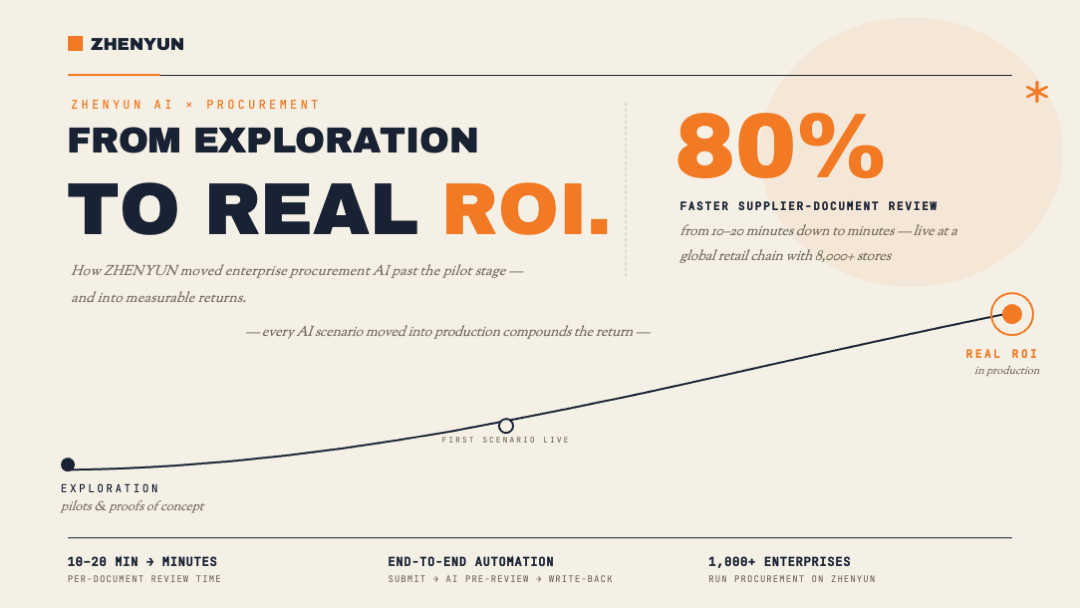
Review time per document: from 10–20 minutes down to minutes.Efficiency gain: 80%.Fewer misjudgments. Fewer missed issues. Lower labor and management costs.
For a retailer expanding aggressively in the Chinese mainland, faster supplier onboarding means faster store openings — and a finance team freed up for work that actually needs human judgment.
What's Next
This launch is just the first move. The two teams are already looking at other procurement scenarios where AI can take on the heavy lifting, building toward a broader "AI + Procurement" model for the business.
For ZHENYUN, it's one more proof point of what happens when two decades of procurement know-how meets modern AI: the paperwork disappears, and the real work gets faster, and finally AI becomes practical and generates real ROI.


